

BelEdit Book Reviews
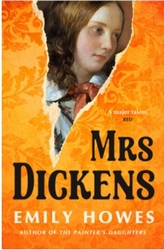
When I think of Charles Dickens, I picture the man who wrote Oliver Twist and David Copperfield. I think of the jilted Mrs Haversham and of Little Dorrit dutifully caring for her father in a debtor’s prison. I think of all those characters who embodied humour and love and struggling through literal hard times. I had a vague idea that Dickens grappled with his demons, and recall the story that he would converse with his characters as though they were in the room with him. Like millions of people over the past 200-odd years, I’ve laughed and cried over his books, loved them and cherished them. But what was he really like? And what about the woman who shared his life? Mrs Dickens pulls back the curtain on Catherine (Kate) Dickens, née Hogarth, the forgotten wife of the famous and beloved author. It’s not a pretty picture.
This isn’t just a story about a famous marriage gone wrong. It’s about what it meant to be a woman in the 1800s, when your job was to be quiet, obedient and grateful for whatever scraps of respect your husband threw your way. Mrs Dickens is a masterclass in feminist biographical historical fiction, focusing on one woman to illustrate the era’s widely-accepted social mores.
In this beautifully written, totally engrossing and unforgettable novel, Emily Howes illuminates how little control women had over their bodies, their money, even their own minds.
Warning – This review contains spoilers! If you don’t want to know too much about the book, and would rather read it for yourself, please… stop reading now and buy the book. It’s a 5-star read and any fan of historical fiction [interested in the Dickens household] is bound to enjoy it! If you’re curious to know more now, read on.
The man behind the myth
Charles Dickens was a genius, no doubt about it. But Mrs Dickens shows us the man behind the books. It demonstrates unequivocally that he was a jerk. The same man who wrote about love and kindness and justice treated his wife appallingly, and created a deeply disfunctional family home.
Kate loved him. She had his children — ten of them. She had miscarriages. She suffered postnatal depression. She ran his household, hosted his parties and pandered to his moods, not to mention having to feign tolerance of him showing loving kindness to other women. In return she suffered continual criticism, control and threats. At one point, Dickens even tried to have her locked up in an asylum to get her out of his way.
Kate the wife, Anne the maid
The book flips between Kate’s story and that of Anne Brown, her maid. Anne’s not just a background character. She illustrates what life was like for women who didn’t even have Kate’s relative privilege. Anne grew up poor, lost her family and ended up working for the Dickens household just to survive. Survival meant keeping her head down, even when she saw the way Charles treated Kate.
Anne’s loyalty to Kate is real, but so is her fear. She knows if she steps out of line, she’s out on the street. But Kate, for all her husband’s fame and wealth, is even more trapped than Anne, who at least could potentially leave if she found other employment. Both are at the mercy of this manic man and his unpredictable moods. He controls their lives like a jailer, doling out or withholding freedoms and favours on a whim.
For Mrs Dickens, Howes has used historical documents (letters and other contemporary accounts) to create a semi-fictional world where her characters come alive in all their human complexity. Charles is not just a hypocritical, domineering, narcissistic husband and father. We do glimpse his charisma, the fun he could create around him when at his best (or most manic, at least) and his creative brilliance. Indeed we can even pity him: for his self-deception, for his loneliness. Kate is not just the passive victim of his moods and the target of his venom and gaslighting. We also see her love for him and her children, and for Anne. We see her perseverance and her creativity, expressed lovingly through cooking and other domestic tasks. And we feel, painfully, her quiet desperation as the years wear her down from loving wife to discarded burden.
As I came to the end, I was very moved by the fact that Mrs Dickens gave Kate the one thing she was denied in life: a voice.
A window into Victorian domestic life and social expectations
Mrs Dickens is both biography and social commentary, and it’s important on both levels. First, it kills some of the myths about Charles Dickens by revealing his domestic life and true nature. Secondly, it’s about all the women history has pushed to the side — the ones who kept things running while the men got all the credit.
More specifically, Mrs Dickens is a searing indictment of the societal structures that trapped women like Kate and Anne. It provides a window into the suffocating expectations put upon Victorian wives, expected to support their husbands unquestioningly till their own identity was subsumed by his.
This is not a new topic for fiction, not at all; where Mrs Dickens shines is in its portrayal of the psychological toll this takes, in an era where a woman’s worth was measured by her obedience. Kate’s depression, grief and her quiet resistance are all met with Dickens’ dismissiveness or outright hostility and threats. Like abused women in every place and era, Kate’s submissiveness is not a flaw but a survival tactic.
As a working-class woman, Anne Brown’s options are even more limited. Her own survival depends on navigating the power dynamics of the Dickens household, even if that pits her against Kate.
Recommended for fans of insightful biographical historical fiction
If you love historical fiction that shines a spotlight on women rather than the “great men” of history, this is for you. I’m sure that for many readers, it will stick with you long after you’ve turned the last page.
How much is true and how much is imagination and speculation? I can’t say. The afterword highlights where the author has rewritten history to serve the narrative. Perhaps scholars might quibble, but I think the ordinary reader will feel that the incidences – such as changing the date when the family moved from one home to another – are so minor as to be negligeable.
In short, Mrs Dickens is informative, moving and unforgettable — a term loosely bandied about no doubt, but most aptly applied to this novel.
Thanks to the author, publisher and Netgalley for the ARC. All my reviews are 100% honest and unbiased, regardless of how I acquire the book. And they are written by me, not AI.
You might also like: The Maiden of Florence – Katherine Mezzacappa