

BelEdit Book Reviews
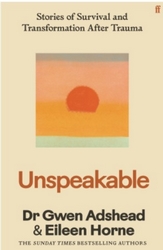
Unspeakable – Stories of Survival and Transformation After Trauma is the second book by Dr Gwen Adshead and Eileen Horne recounting stories of people undergoing psychotherapy; in this case, therapy for trauma. It attests to how psychotherapeutic support can nurture an individual’s resilience and capacity for healing to bring lasting transformation.
Unspeakable, just like the first book (The Devil You Know – Stories of Human Cruelty and Compassion) is deeply moving. A red thread in the different stories is the premise that people are unique individuals and respond to trauma in very different ways. Even the same trauma can affect individuals differently, according to their unique background, environment and mental state at the time of the incident.
The book is divided into chapters focusing on different types of trauma: being a refugee, a hostage, a survivor of abuse or a mortal accident, etc. The case histories are presented by recounting the patients’ development over a series of consultation sessions. As in the previous book, the authors state that, for the sake of patient confidentiality and clarity of narrative, the portraits may be composites of different clients and situations. It hardly matters: these stories are to be read not as factual accounts about specific individuals but as illustrations of psychological patterns and of the range of responses humans may have to psychological and physical traumas.
Finding words for the unspeakable
While Unspeakable is ‘about’ trauma responses, it also enlightens the reader about the psychotherapeutic process. A process that facilitates moving from a state for which the individual literally has ‘no words’, or is incapable of putting into words, to a state where the experience and its impact can be verbalised and processed. To emphasise the point, one chapter even deals with a mute child – who has not uttered a word since their trauma occurred – and his mother. Their story is so quietly heartrending that I sobbed as I read it.
Eileen Horne is a wonderful writer, bringing Dr Adshead’s stories – and her skill and empathy – to the page in heartfelt but unsentimental prose.
Postscript - Some readers might be frustrated that this book sometimes gives the impression that patients seem to 'recover' after just a few short consultations. This misses the point: these are 'stories', not to be read as purely factual accounts. Psychotherapy is a long process and allowances must be made to summarise such a journey into a single chapter in a book.
My thanks to the authors, publisher and Netgalley for giving me a free copy of this book. All my reviews are 100% honest and unbiased, regardless of how I acquire the book. And they are written by me, not AI.
You might also like: The Devil You Know – Dr Gwen Adshead and Eileen Horne